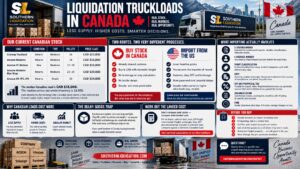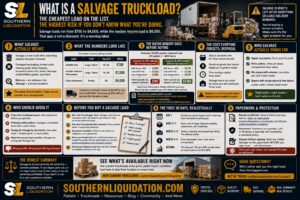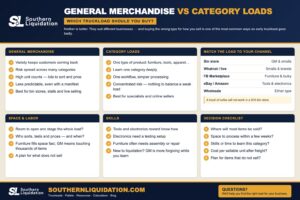
When you start pricing liquidation truckloads you quickly run into two broad types. There are general merchandise loads — a mix of home goods, toys, kitchen, electronics, apparel, health and beauty and everything in between. And there are category loads, where the whole truck is furniture, or tools, or apparel, or small electronics.
Neither is better. They suit different businesses, and buying the wrong type for how you sell is one of the most common ways a first or second truckload goes badly.
What you get with general merchandise
A general merchandise (GM) load is the variety pack of liquidation. It is what most people picture when they think of returns pallets.
- Variety. Lots of different items keeps customers interested, which is exactly what bin stores, flea market stalls and live selling shows need.
- Spread-out risk. If one category in the load is weak, others usually make up for it.
- High unit counts. More items to sort, price and sell — good if you have the labor, painful if you do not.
- Less predictability. Even with a manifest, you will not know exactly what is coming until the pallets are open.
What you get with a category load
A category load concentrates everything into one type of product. Furniture, tools and home improvement, apparel and small appliances are common examples.
- Specialization. You can learn one category deeply — what sells, what to test, what it is worth.
- Simpler processing. One workflow, one type of listing, one set of packaging needs.
- Concentrated risk. If the category is soft or the load is heavy on damage, there is nothing else in the truck to balance it out.
- Specific channel fit. Bulky goods work for local pickup; small high-value goods work for shipping.
For a closer look at what category loads contain, see our breakdowns of furniture truckloads and tools and MRO loads.
Match the load to where you sell
The single best question to ask before buying is: where will these items actually be sold?
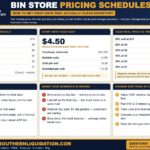
- Bin store: General merchandise or smalls. Customers come for the treasure hunt, so variety matters more than any one item.
- Whatnot or other live selling: Smalls and recognizable brands. Items need to be quick to show and cheap to ship.
- Facebook Marketplace and local pickup: Furniture, patio, fitness and other bulky categories. Shipping costs would kill these online, but locally they sell well.
- eBay and Amazon: Higher-value category loads such as tools or electronics, where each item is worth the time to test, photograph and list.
- Wholesale to other resellers: Either type, as long as you can break it down into pallets buyers want.
If your channel and the load do not match, you end up with stock that sits. A truck of sofas will not work in a $10 bin store, and a pallet of phone cases is a slow way to fill a furniture showroom.
Think about space and labor
A furniture load fills a warehouse fast and needs two people and a dolly to move. A GM load might be the same number of pallets but contain thousands of individual items that each need to be touched. Ask yourself:
- Do I have room to open and stage the whole load, or will it sit wrapped for weeks?
- Who is sorting, testing and pricing, and how many hours a week do they have?
- What happens to the items that do not sell — do I have a way to clear them?
Our guide to storing and organizing liquidation inventory covers this in more detail.
Think about skills
Category loads reward knowledge. Someone who knows power tools can test, grade and price a tool load much better than someone who does not, and will spot the high-value items quickly. Electronics loads need a testing setup. Furniture often needs minor assembly or repair. If you do not have the skills yet, a GM load is usually more forgiving while you learn.
Compare loads on value, not pallet count
Two trucks with the same number of pallets can be completely different deals. Furniture takes up a lot of space for its value, so per-pallet retail value is usually lower; smalls and electronics pack much more value into each pallet. Compare loads on percent of retail and realistic sell-through by category, and remember freight costs the same per truck whether the load is worth $20,000 or $80,000 at retail. Our article on freight costs explains how that plays out.
A quick decision checklist
- Where will most of these items be sold?
- Do I have the space to process this load within a few weeks?
- Do I have the skills — or the time to learn — for this category?
- What is my cost per sellable unit after freight?
- What is my plan for the items that do not sell?
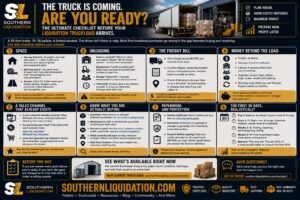
If you can answer all five, you are ready to buy. Our first truckload checklist goes through the rest of the preparation, and you can browse current general merchandise and category loads on our programs page. Not sure which fits? Tell us how you sell and we will point you in the right direction.