You sell an item for $50. How much reaches your bank account?
Most resellers guess. The guess is usually optimistic, and on liquidation stock — where margins are made in small increments across a lot of units — being wrong by a few percent on every sale is the difference between a profitable load and a busy one.
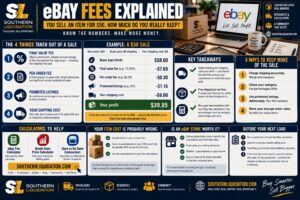
The four things taken out of a $50 sale
Four separate deductions, and they are not all obvious:
- Final value fee. eBay’s commission, charged as a percentage of the total amount the buyer pays — including the shipping they paid. This is the one people get wrong.
- Per-order fee. A fixed amount on each order, small individually and significant across hundreds of low-value sales.
- Promoted listings. If you are using them, an additional percentage on any sale attributed to the promotion.
- Your shipping cost. Not a fee, but it comes out of the same $50 and is frequently underestimated.
Final value fee percentages vary by category, so a tool, a piece of clothing and a phone accessory are not charged identically. Our eBay fee calculators let you pick the category rather than working from a single average.
Working a $50 sale through
Say you sell an item for $50 with $8 shipping paid by the buyer, and it costs you $9 to actually ship.
- Buyer pays $58
- Final value fee is charged on the full $58, not on $50 — this is the step most people miss
- A per-order fee comes off as well
- Your actual shipping cost of $9 comes out — a dollar more than the buyer paid
Two lessons fall out of this. First, undercharging for shipping costs you twice — you absorb the shortfall and you pay commission on the amount the buyer did pay. Second, free shipping is not free: it raises your item price, which raises the fee charged on it.
Rather than reproduce percentages here that change without notice, put your own numbers into the net profit calculator. It asks for sale price, category, item cost, shipping and promoted listings percentage, and tells you what you keep.
The number that actually matters: break-even
Knowing what you keep is useful after the fact. Knowing your break-even price is useful before you list.
Break-even is the minimum you can sell at without losing money once fees and shipping are accounted for. It is the number that should set your lowest acceptable offer and your auction reserve.
The break-even price calculator takes your item cost, your shipping cost and the category, and gives you that figure — with an optional field for the profit you actually want, which turns it into a target price rather than a floor.
For liquidation resellers this matters more than for most sellers, because your cost per item is often uncertain. Which brings us to the thing that undermines the whole calculation.
Your item cost is probably wrong
Every fee calculation depends on knowing what the item cost you. If you bought a truckload, you know what the load cost. Dividing by the number of items gives an average that is wrong for almost every individual item.
A better approach:
- Work out your true cost per item including freight, not just the load price — our cost per item calculator does this
- Then weight it. If 30% of the load will not sell, the sellable 70% has to carry the cost of the whole thing. Your effective cost per sellable item is meaningfully higher than the simple average
- Use that weighted figure in your fee calculations, not the raw one
This is the most common way liquidation resellers convince themselves a load was profitable when it was not. Percent of retail covers the same trap from the buying side.
Is an eBay Store worth it?
A store subscription costs a monthly fee and reduces your final value fees, plus gives you a listing allowance. Whether it pays depends entirely on your volume — and there is a crossover point where it starts making sense.
Rather than guessing, our Store vs No Store comparison takes your monthly sales volume and shows both scenarios side by side.
The rough shape: at low volume the subscription costs more than it saves. At high volume it is straightforwardly worth it. The useful question is where you sit, and that is a calculation rather than an opinion.
For anyone working through a truckload, the answer is usually yes — a truckload generates enough listings to justify the allowance on its own.
Four ways to keep more of the sale
- Charge shipping accurately. Weigh and measure. Absorbing a dollar per order across 500 orders is $500.
- Check your category. Fee percentages differ, and items listed in the wrong category cost more as well as selling worse.
- Use promoted listings deliberately. They work, and they are an additional percentage. Run the numbers rather than applying a blanket rate.
- Raise your average order value. Per-order fees are fixed, so the same fee on a $40 sale hurts far less than on a $8 one. Bundling low-value liquidation items is often more profitable than listing them individually.
Before your next load
Work out what you keep before you buy, not after. Run a typical item through the eBay calculators, use that to set your realistic selling price, and feed that price into the load profitability calculator.
If the load only works at prices you cannot actually achieve after fees, it is the wrong load — and that is far cheaper to discover on a calculator than on a driveway.
Our current truckloads list prices, pallet counts and conditions, and what a liquidation truckload actually costs covers the buying side in full.