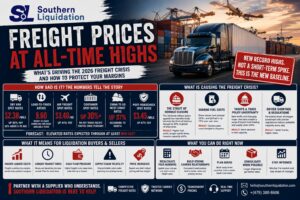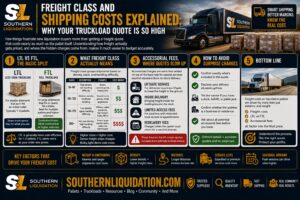
Few things frustrate new liquidation buyers more than getting a freight quote that costs nearly as much as the pallet itself. Understanding how freight actually gets priced, and where the hidden charges come from, makes it much easier to budget accurately and avoid surprises.
LTL vs. FTL: The Basic Split
Less-than-truckload (LTL) shipping is used when your order doesn’t fill an entire trailer, typically for one to a handful of pallets, and you share truck space with other shippers’ freight. Full truckload (FTL) shipping is used for larger orders that fill or nearly fill a trailer on their own. LTL is generally more cost-effective for a single pallet or two, while FTL becomes more economical once you’re ordering multiple pallets or a partial truckload’s worth of inventory.
What Freight Class Actually Means
Freight class is a standardized rating system used across the LTL industry that groups shipments based on density, value, handling difficulty, and liability risk. Lower classes generally apply to dense, sturdy, easy-to-handle freight and cost less to ship; higher classes apply to bulky, fragile, or low-density freight and cost more. A pallet of dense general merchandise will typically ship cheaper than an equally heavy pallet of bulky, lightweight items like pillows or lampshades, simply because of how freight class pricing works.
Accessorial Fees: Where Quotes Blow Up
Accessorial charges are additional fees added on top of the base freight rate for services beyond standard dock-to-dock delivery. Common ones include liftgate service if you don’t have a loading dock, inside delivery if the driver has to bring the pallet past the curb, limited access fees for residential or hard-to-reach locations, and redelivery fees if no one is available to receive the shipment. These fees can add a significant percentage on top of the base rate, and they’re the single biggest reason an initial quote balloons by the time the final invoice arrives.
How to Avoid Surprise Charges
Before booking freight, confirm exactly what’s included in the quote and disclose your actual delivery situation upfront, including whether you have a dock or forklift, whether the delivery address is a business or residence, and whether someone will be available during the delivery window. Getting a quote based on inaccurate assumptions about your location is the most common way accessorial fees show up as an unpleasant surprise on the final bill.
Bottom Line
Freight costs on liquidation pallets are driven by more than just distance and weight. Freight class, LTL versus FTL, and accessorial fees for things like liftgates and limited-access delivery all factor into the final price. Asking detailed questions upfront and being upfront about your delivery situation is the most reliable way to avoid a quote that’s much higher than expected.