Canadian resellers face a problem American ones do not: there is far less domestic liquidation supply, and most of what is written about buying truckloads assumes a US address.
The result is that Canadian buyers either pay a premium for domestic stock or try to import from the US and discover the paperwork afterwards. Both are workable. Neither is obvious.
Canadian loads cost more, and here is the evidence
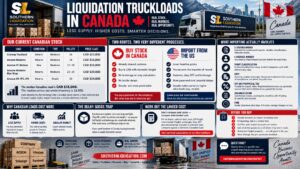
Our current Canadian stock:
| Load | Condition | Type | Pallets | Price |
|---|---|---|---|---|
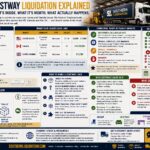
| Costway Truckload | Returns | Mediums | 26 | CAD $12,000 |
| Amazon Mediums | Returns | Mediums | 24 | CAD $15,000 |
| Amazon FC Medium | New | Mediums | 12–24 | CAD $15,000 |
| Amazon Mediums Blue Wrap | Returns | Mediums | 22–24 | CAD $20,000 |
| Amazon 6ft HPC LPN | Returns | Smalls | 24 | CAD $29,000 |
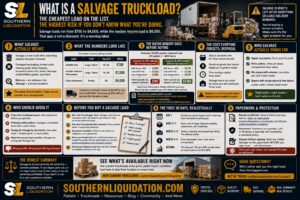
The median Canadian load is CAD $15,000. The median across our whole inventory is $8,500. Even allowing for the exchange rate, Canadian stock carries a real premium.
That is not opportunism. It reflects a smaller domestic market, less supply reaching Canada in the first place, and the cost of getting goods there. Budget above what a US comparison suggests — and note there is no Canadian equivalent of the $750 salvage loads that exist elsewhere.
Two routes, and they are genuinely different
Buying stock already in Canada
Simplest by a wide margin. The goods have already cleared customs, so you are buying domestic stock with domestic freight. No brokerage, no duty calculation, no border delay, no surprise bill weeks later.
You pay for that simplicity in the price. The premium in the table above is largely the cost of importing, already absorbed by someone else.
Importing from the US
Lower headline price, considerably more involved. You become the importer of record, with everything that carries.
What importing actually involves
If you go this route, these are the pieces:
- A customs broker. Effectively essential for commercial truckload imports. They handle classification, filing and release. Budget for their fee as a real line item.
- A business number with an import/export account. Required to import commercially. Sort it out before the load ships, not while it sits at the border.
- Tariff classification. A mixed truckload contains dozens of product categories, each with its own classification and duty rate. This is precisely why brokers exist — a general merchandise load is not one tariff line.
- Duty. Varies by product and origin. Goods manufactured outside North America and shipped via a US warehouse are treated on their origin, not on where they shipped from — this catches people out.
- GST, and provincial tax depending on your province. Payable on import value. Registered businesses can generally recover GST, but it still has to be paid at the border, so it is a cash flow event.
- Documentation. Commercial invoice, packing list, manifest, bill of lading. A vague description on a commercial invoice causes delays.
- Time. Border clearance adds days. If clearance stalls, storage charges accrue.
We are not customs brokers and none of this is professional advice. Speak to a broker before you commit to an import — a half-hour conversation is far cheaper than a load stuck at the border.
Working out which is cheaper
Do not compare the load prices. Compare landed cost.
For an import, add up: load price, US-side freight, cross-border freight, brokerage, duty, GST and provincial tax, and the cash cost of the delay. Convert to CAD. Then compare against a domestic Canadian load delivered to your door.
The gap is usually narrower than the headline prices suggest, and on smaller loads importing frequently costs more once everything is counted. It tends to make sense on higher-value loads where the fixed costs spread across more retail value — which is a reasonable argument for the Amazon smalls load in the table rather than a bulky furniture one.
Run both scenarios through our load calculators before deciding.
The bulky goods trap
One specific warning. Importing bulky, low-value-density goods across a border is usually a poor trade.
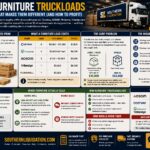
Furniture and outdoor items fill a trailer by volume rather than weight, so you pay full freight and full brokerage on a load holding relatively little retail value — and then pay duty on top. Our furniture guide explains the cube problem in more detail; it gets considerably worse with a border in the middle.
If you want furniture in Canada, buying domestic stock is usually the better answer even at the higher price.
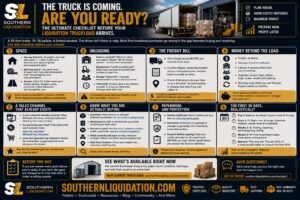
Before you buy
- Decide domestic or import on landed cost, not headline price.
- If importing, talk to a broker first. Before you commit, not after.
- Confirm your import accounts are active. Border delays are expensive and entirely avoidable.
- Ask what the goods are and where they were made. Origin drives duty.
- Quote the freight properly — we will quote it before you commit, including cross-border where relevant.
- Work through the pre-purchase checklist, which applies on either side of the border.
Current Canadian stock
Our Canadian loads are listed with the rest of our truckload inventory, priced in CAD, and you can filter to Canada. If you would rather not deal with importing at all, those are already in the country.
If you want to know whether a specific US load is worth importing to your province, ask us — we would rather work through the numbers with you than sell you a load that costs more than it should once it lands.