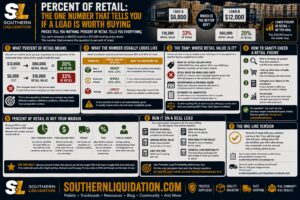
Two truckloads sit in front of you. One is $6,000. One is $12,000. Which is the better buy?
You cannot answer that, and neither can we, because the prices tell you almost nothing on their own. The number that answers it is percent of retail — and once you start thinking in it, most of the confusion around liquidation pricing disappears.
What percent of retail means
Percent of retail is what you pay expressed as a proportion of the estimated retail value of the goods inside the load.
If a truckload holds $60,000 of merchandise at retail prices and costs you $12,000, you are buying at 20% of retail. If a $6,000 load holds $18,000 of retail, you are buying at 33% of retail.
The cheaper load is the worse deal. It costs half as much and gives you less room to make money.
This is the calculation that lets you compare loads that have nothing else in common — different retailers, different conditions, different sizes. It reduces everything to one comparable number.
What the number usually looks like
Across the market, most truckloads land somewhere between 10% and 35% of estimated retail. Where a specific load falls depends mostly on condition:
| Condition | Typical percent of retail | What you are paying for |
|---|---|---|
| New / overstock | Higher | Goods that are sellable immediately, with predictable sell-through |
| Customer returns | Middle | A mix, where some proportion needs work or will not sell at full value |
| Salvage | Lowest | Recovery value only — much of the load is not sellable as retail goods |
A low percent of retail is not automatically good. It usually means the seller expects a large share of the load to be unsellable. You are being compensated for risk, not handed a discount.
The trap: whose retail value is it?
Here is the part that costs people money.
Percent of retail is only as reliable as the retail figure it is calculated from — and that figure is supplied by the seller. There is no independent authority checking it.
Things to watch for:
- MSRP versus actual selling price. A product with a $199 MSRP that has sold at $79 for two years is not a $199 item. Manifests routinely use the higher number.
- Retail value on unsellable units. If 20% of a returns load is damaged beyond resale, that 20% still appears in the manifest’s retail total.
- Discontinued and seasonal goods. Retail value assumes someone still wants it. Christmas stock in February has a retail value on paper and a much lower one in practice.
- Estimated versus manifested. An estimate on an unmanifested load is exactly that. Treat it as a guide, not a number to build a business plan on.
A seller quoting 8% of retail on a load with an inflated retail figure may be offering you a worse deal than one quoting 25% on an honest one. The percentage is only useful if the denominator is real.
How to sanity-check a retail figure
You do not need to verify every line. You need to verify enough to know whether the total is plausible.
- Pick five to ten items at random from the manifest — not the most expensive ones, random ones.
- Look up what they actually sell for today, not their MSRP. Check the live listing price and, where you can, recent sold prices.
- Compare your figure to the manifest’s. If your sample comes in 40% below what the manifest claims, assume the whole total is inflated by roughly that much.
- Recalculate. Apply your corrected retail total and see what percent of retail you are really buying at.
If a load has no manifest at all, you cannot do this — which is the real argument for manifested loads, and something we cover in our guide to salvage and unmanifested stock.
Percent of retail is not your margin
Buying at 20% of retail does not mean an 80% margin. It is the starting point of a calculation, not the end of one.
Between that number and your actual profit sit:
- Sell-through rate. You will not sell 100% of a load. What you do not sell has to be carried by what you do.
- Your actual selling price. Almost nobody sells liquidation goods at full retail. If you sell at 60% of retail, your effective margin is calculated against that, not against MSRP.
- Freight. Add it to the cost side before you calculate anything.
- Fees. eBay, Whatnot, Amazon and every other channel take a cut. Our eBay and Whatnot calculators will tell you what you actually keep.
- Time and labour. Sorting, testing, photographing and listing a truckload is real work with a real cost, even when you are doing it yourself.
A useful rule: take your percent of retail, then assume you will sell roughly 70% of the load at roughly 50% of its retail value. If the maths still works after freight and fees, the load is worth buying. If it only works at 100% sell-through and full retail, it is not.
Run it on a real load
Rather than working through this by hand, our load and pallet calculators will do it for you. There are six of them:
- Percent of Retail — enter the total retail value and the cost of the load
- Average Retail Value — retail value divided across the unit count
- Cost Per Item and Cost Per Pallet — what you are paying per unit at each level
- Profitability Per Pallet — margin if you are reselling by the pallet rather than by the item
- Potential Load Profitability — the full picture, including the percentage of retail you expect to sell at
That last one is the one to use before you buy. It is the only calculator here that asks the honest question: not what the load is worth, but what you will realistically get for it.
The one-line version
Percent of retail tells you whether a price is fair. Your sell-through rate and your selling price tell you whether you will make money. You need both, and the second one is entirely down to you.
If you want to see current loads with prices, pallet counts and conditions on every one, they are listed here. And if you are still working out what a truckload should cost in the first place, we have published our full price ranges across 70 live loads.