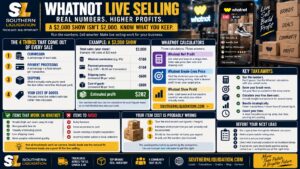
You run a two-hour show and finish on $2,000 in sales. That number feels like the result. It is not — it is the top of a calculation, and what reaches your account is a good deal less.
For liquidation resellers this matters more than for most Whatnot sellers, because your sourcing cost is spread across a whole truckload and your margin per item is thin by design. Being vague about fees is how a busy show turns out to have been a break-even one.
Note: Whatnot updated its fee structure in 2026, including a new threshold that changes what some sellers pay. We cover that change separately in our guide to the 2026 fee update — this article is the evergreen how-the-maths-works version.
What comes out of a show
Three deductions, plus one cost that is not a fee but behaves like one:
- Commission — a percentage of each sale
- Payment processing — a percentage plus a fixed amount per transaction
- Shipping — what it actually costs you to send the item, which is rarely exactly what the buyer paid
- Your cost of goods — the part most live sellers estimate rather than calculate
The per-transaction element of payment processing is the one that quietly hurts. It is charged per sale, not per show, so a show made up of a hundred $20 sales absorbs that fixed cost a hundred times. Two hundred $10 sales absorb it two hundred times.
That is the single most important structural fact about live selling liquidation stock: low-ticket, high-volume shows are hit hardest by per-transaction costs.
Run your own numbers
Rather than publishing percentages that will be out of date the moment Whatnot changes them, use the Whatnot calculators. There are three, and they answer different questions:
- Whatnot Net Profit — for a single item. Enter the sale price, what the item cost you and your shipping cost, and see what you keep.
- Whatnot Break-Even Price — the reverse. Enter your cost and shipping, and get the minimum you can let something go for. This is the number to know before you start the show, not during it.
- Whatnot Show Profit — the whole session. Enter total sales and transaction count and see what the show actually produced.
That last one is the useful one, and almost nobody does it. Run it after every show for a month and you will have a real picture of what your shows earn per hour.
The break-even number changes how you sell
Live selling is fast. Items go for what the room will pay, and in the moment it is easy to let something go too cheaply.
Knowing your break-even price in advance changes that. Before a show, work out the floor for your main item tiers — your $5 items, your $20 items, your $50 items — and know where you stop.
The break-even calculator has an optional “desired profit” field, which turns a floor into a target. Use it. The difference between selling at break-even and selling at a target across a whole show is the entire margin.
Cost per item, when you bought a truckload
Every calculation above needs your cost per item, and if you bought a truckload you do not have one — you have a load price.
Dividing the load price by the number of items gives an average that is wrong in an important way: it assumes you sell everything. You will not.
Do this instead:
- Take the total landed cost of the load — goods plus freight, not just the invoice
- Estimate what proportion you will actually sell. Be pessimistic
- Divide the total cost by the number of items you expect to sell, not the number you received
That weighted figure is your true cost per sold item, and it is the number to put into the Whatnot calculators. Our cost per item calculator will do the first part; percent of retail explains why the unsold portion has to be carried by the sold portion.
Where live sellers lose money without noticing
- Shipping estimated rather than weighed. A dollar per parcel across a busy show is real money, and it comes straight off the bottom.
- Giveaways not costed. They build an audience and they still cost you goods and postage. Count them.
- Unsold stock ignored. What does not sell on camera does not vanish. It has to be carried by what did.
- Time not valued. A show is not just the airtime. It is sourcing, prep, the show, then packing and posting. Divide your show profit by the real hours before deciding it went well.
- Bundling too cheaply. Bundling reduces per-transaction costs, which is good — but only if the bundle price reflects what is in it.
Which loads suit live selling
Not all truckloads work on camera. What does:
- Smalls. High unit count, cheap to ship, quick to show. The natural fit — and worth knowing that smalls loads carry the highest median price in our inventory precisely because the value density is there.
- Recognisable brands. A room bids faster on something it knows.
- Visually interesting goods. Live selling is a visual medium.
What does not: bulky furniture, anything expensive to post, anything needing a lengthy explanation. Our furniture loads are a poor fit for live selling and a good fit for local collection — different channel, different load.
Before your next load
Work out what a typical item nets you after fees, then work backwards to what you can afford to pay for a load. That order — fees first, then buying decision — is the one that keeps shows profitable.
Run the numbers in the Whatnot calculators, then look at what is actually available. If you want to know which of our current loads suit live selling, tell us what you sell and we will point you at the right ones.