A 53-foot trailer is arriving with somewhere between 15 and 26 pallets on it. It will be at your location for a limited window, and the driver is not there to help you unload.
Most first truckload purchases go wrong in the gap between buying and receiving. Not because the load was bad — because nobody thought through what happens when it turns up. This is the checklist to work through before you commit.
1. Space
A truckload is not a pallet. Plan for it properly.
- Storage footprint. A standard pallet is 48 x 40 inches. Twenty-four of them, stacked one high with room to walk between rows, needs roughly 1,000 to 1,200 square feet. You can stack to reduce that, but only if the goods and your equipment allow it.
- Working space on top of storage. You need somewhere to open, sort, test and photograph. If your storage area is also your working area, you will spend the first week moving pallets around to reach other pallets.
- Access. Can a 53-foot trailer physically reach you? Tight residential streets, low bridges, overhanging trees and sharp turns all cause failed deliveries, and a failed delivery is charged to you.
If you do not have space, that is a solvable problem — but solve it before you buy, not after. We have written about storing liquidation inventory without renting a warehouse.
2. Unloading
This is the single most underestimated item on the list.
- Dock or no dock? With a dock, pallets come off quickly with a pallet jack. Without one, you need a liftgate on the truck, and every pallet comes down individually. Say so when you book — a truck that arrives without a liftgate you needed cannot deliver.
- Forklift or pallet jack. A pallet jack works on a flat, hard surface. It does not work on gravel, grass or a sloped driveway. Know which you need and have it on site that day.
- People. A palletised load with a dock and a jack is a two-person job. A floorloaded trailer — boxes stacked loose, no pallets — is a different order of work entirely and can take a small team most of a day.
- Time limit. Drivers allow a set window, typically a couple of hours. Past that, detention charges begin. Have your people there before the truck arrives, not on their way.
If you are buying floorloaded because it was cheaper, price the extra labour before deciding it was cheaper.
3. The freight bill
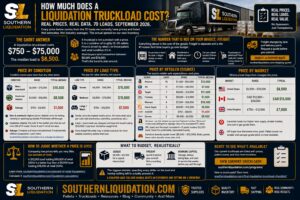
Goods and freight are separate costs, and freight is where budgets break.
- Get the freight quote before you commit to the load, not after.
- Confirm whether the quote includes a liftgate, residential or limited-access delivery, and an appointment window. Each is usually an extra.
- Check whether the price is to your door or to a terminal. Terminal collection is cheaper, but only if you can collect a full truckload from one.
We will quote freight on any load before purchase — request a shipping quote here.
4. Money beyond the load
The load price is not the capital requirement.
- Freight, as above.
- Storage, if you are renting it.
- Labour, if anyone other than you is working.
- Supplies — boxes, poly bags, labels, tape, a scale. Small individually and surprising in aggregate.
- Running costs while you sell through. A truckload does not convert to cash in a week. Depending on channel and volume, expect weeks to months. You need to eat during that period.
The most common failure we see is a buyer spending everything on the load and having nothing left to process it with. A smaller load you can fully work through will make you more money than a larger one you cannot.
5. A sales channel that already exists
Do not buy inventory and then work out where to sell it.
- Is your channel already running? An eBay account with feedback, a live Whatnot show with an audience, a bin store with a lease, an existing customer list. Starting a channel from zero while sitting on 24 pallets is a hard way to learn.
- Do you know your fees? Work out what you actually keep before you buy. Our eBay fee calculators and Whatnot fee calculators will tell you.
- Does the load suit the channel? Smalls suit online listing and live selling. Large and mechanical goods suit local pickup and bin stores. A truckload of patio furniture is a difficult thing to ship one item at a time.
6. Know what you are actually buying
Before you commit, you should be able to answer all of these:
- Condition — new, customer returns, or salvage? These are not variations on a theme; they are different businesses. Our guide to salvage loads explains the difference.
- Manifested or not? A manifest lets you check what is inside and sanity-check the retail value. Without one you are buying on trust.
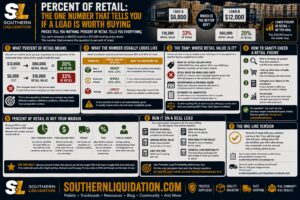
- Percent of retail. Not the price — the price relative to what is inside. Here is how to calculate it and where the traps are.
- Pallet count and load type. Smalls, mediums or large? This determines unit count, storage and how long processing takes.
- Ship-from location. It drives your freight cost more than anything else.
7. Paperwork and protection
- Resale certificate. Have it before you buy, not during the transaction. Our state-by-state guide covers the basics.
- Insurance. Stock sitting in a garage or unit is generally not covered by a standard household policy.
- Inspect before signing. Once you sign the delivery paperwork clean, you have accepted the load as delivered. Walk it first, and note any visible damage on the paperwork before you sign — not afterwards.
8. The first 30 days, realistically
A rough shape of what actually happens:
- Day 1: Delivery and unload. Expect this to take most of a day, more if floorloaded. Do not schedule anything else.
- Days 2–7: Open, sort and triage. Separate sellable, needs-work and unsellable. This is where you find out what you actually bought.
- Weeks 2–3: Testing, cleaning, photographing, listing. The slowest phase and the one people underestimate most.
- Weeks 3–4: First meaningful sales. Cash starts coming back.
- Beyond: The long tail. The last 20% of a load usually takes as long to sell as the first 80%.
Before you buy
If you can answer every point above, you are ready. If you cannot, the gaps are cheaper to fix now than after a trailer is sitting outside.
Our current truckloads list price, pallet count, condition, load type and ship-from location on every load, so you can work through this checklist against a specific one. If you would rather talk it through first, get in touch — we would rather sell you the right load than the biggest one.