“How much of this pallet will actually sell?” is the single most important question in this business, and vague answers like “most of it” or “it depends” don’t help you price a load or decide whether to buy it. Below are realistic sell-through ranges by category, why the range is so wide even within one category, and a simple formula you can use to estimate expected recoverable revenue before you ever click “buy.”
What “Sellable” Actually Means Here
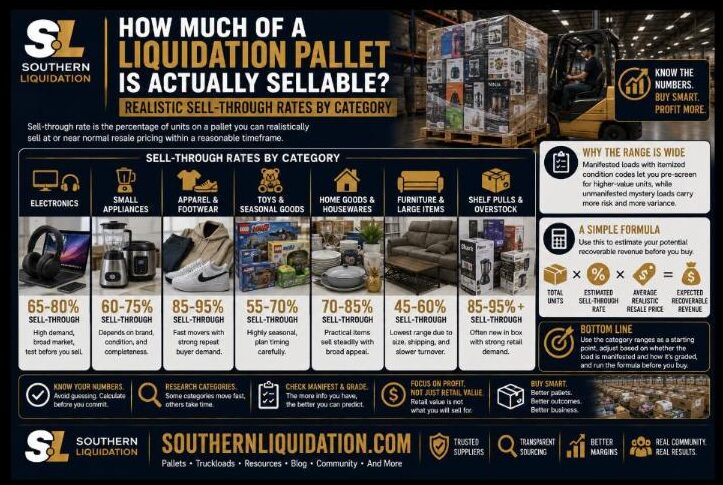
Sell-through rate is the percentage of units on a pallet you can realistically sell at or near normal resale pricing within a reasonable timeframe, not the percentage you could theoretically unload for pennies in a bulk lot. Every load also has a smaller bucket of parts-only or scrap items that recover some value but shouldn’t be counted in your primary sell-through math. Treat that bucket as a bonus, not part of your plan.
Sell-Through Rates by Category
Electronics: Customer-return electronics typically run 65-80% sell-through. Most units power on and function, but missing accessories, cosmetic damage, or outdated models pull some units into the parts bin. Higher per-unit value means even the lower end of this range can still be profitable.
Small Appliances: Expect roughly 60-75%. Testing takes real time, and units with missing components or heavy wear drag the range down compared to electronics.
Apparel and Footwear: 85-95% by unit count, since most damage is cosmetic (missing tags, minor stains, wrong season). The tradeoff is low per-unit resale value, so this category rewards volume and fast listing over cherry-picking.
Toys and Seasonal Goods: Typically 55-70%. Incomplete sets, missing batteries or parts, and seasonal timing (a Christmas item arriving in March) all lower realistic sell-through.
Home Goods and Housewares: Usually 70-85%. Breakage in transit is the main loss driver here, especially for glass, ceramic, and small kitchen items.
Furniture and Large Items: Often the lowest range at 45-60%, driven by freight damage, missing hardware, and the difficulty of reselling bulky items locally.
Shelf Pulls and Overstock (any category): Because this is new, unsold merchandise rather than returns, sell-through commonly runs 85-95% or higher. This is the main reason overstock loads cost more per unit than customer-return loads of the same category.
Why the Range Is So Wide Within a Single Category
Three factors move you toward the top or bottom of each range. Manifested loads with itemized condition codes let you pre-screen for higher-value, higher-condition units, while unmanifested “mystery” loads carry more risk and usually land toward the bottom of the range. Grading matters just as much: a load graded new or shelf-pull will consistently outperform a load graded customer-returns or salvage. Finally, your own market matters, since a category that sells fast in a busy metro bin store may move much slower through an online storefront with less foot traffic.
A Simple Formula to Estimate Sellable Value Before You Buy
Use this before committing to a load: Expected Recoverable Revenue = Total Units × Estimated Sell-Through Rate × Average Realistic Resale Price. As an example, a 200-unit mixed electronics pallet at a 70% sell-through estimate and a conservative $15 average resale price works out to 140 sellable units × $15, or $2,100 in expected revenue. Compare that number to the delivered cost of the pallet, including freight, before you decide it’s a good buy. Pull your average resale price from actual sold listings in your category, not asking prices, so your estimate reflects what buyers really pay.
Bottom Line
There’s no universal sell-through number that applies to every pallet, but you don’t need one. Use the category ranges above as a starting point, adjust based on whether the load is manifested and how it’s graded, and run the formula before you buy instead of after. That’s what separates resellers who stay profitable from those who get discouraged after one bad pallet.