Every bin store runs on the same basic idea: restock day is full price, the price drops a little every day after that, and by the end of the week whatever is left goes for a dollar or two. Customers understand it instantly, which is a big part of why the model works.
What a lot of new owners miss is that the schedule is not just a promotion. It is the business model. Your starting price, how fast you drop, and where you put the floor decide your average sale price — and your average sale price decides whether a truckload makes money.
What a typical schedule looks like
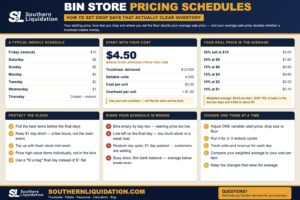
There is no single standard, but a common pattern for a store that restocks once a week looks something like this:
- Restock day (Friday): $10
- Saturday: $8
- Sunday: $6
- Monday: $4
- Tuesday: $2
- Wednesday: $1
- Thursday: closed to clear the bins and restock
Some stores start higher, some drop in smaller steps, some run a “fill a bag” final day instead of a flat price. The specific numbers matter less than whether they fit your cost.
Start with your cost per item, not your competitor’s prices
The most common mistake is copying the schedule of the bin store across town. Their inventory, their rent and what they paid for their loads are all different from yours.
Work it out from your own numbers instead. Say a truckload costs you $12,000 delivered and you expect around 4,000 sellable units out of it. That is $3 per unit before rent, payroll, utilities and bags. If your overhead for the week the load is on the floor adds another $1.50 per item, you need an average sale price comfortably above $4.50 just to stand still.
If you are not sure how many sellable units a load will give you, our guide to realistic sell-through by category and the liquidation pallet calculator are good places to start.
Your real price is the weighted average
Nobody pays $10 for everything. What you actually earn per item depends on how much sells on each day. Here is a simple example using the schedule above:
- 30% of items sell on day one at $10
- 20% sell at $8
- 15% sell at $6
- 15% sell at $4
- 10% sell at $2
- 10% sell at $1
Multiply each price by its share and add them up and you get an average of $6.40 per item. Against a $4.50 break-even, that is a healthy margin. But move just 15% of sales from the first two days to the last two and the average falls to roughly $5 — most of your profit gone, without a single price changing.
That is why the shape of your sales across the week matters as much as the prices on the sign.
Setting the floor
The last day is where most stores leak money. A very low floor clears the bins, but it also teaches customers that patience pays. If your regulars start skipping restock day and only turning up on $1 day, your average price will sink week after week.
A few ways to protect the floor:
- Pull the best items before the final days. Anything still worth real money on day four belongs on a shelf, in a showcase or online — not in a $1 bin.
- Keep the final day short. A few hours of $1 pricing clears stock without making it the main event.
- Restock some fresh items mid-week. A small top-up gives people a reason to come in at higher prices.
Do not put everything in the bins
High-value items do not belong in a flat-price bin on restock day. A $200 robot vacuum at $10 is a gift to resellers who will flip it online. Most successful stores pull anything above a set value and price it individually, sell it on a shelf with a fixed price, or move it through another channel such as live selling. Our comparison of bin stores and Whatnot covers how some owners combine the two.
Signs your schedule is wrong
- The bins are empty by the end of day two. Your starting price is probably too low, or you are not putting out enough stock.
- Lots of stock is left on the final day. Either your restock volume is too high for your foot traffic or the load quality is poor. Look at what is left — it tells you which.
- Restock day is quiet but $1 day is packed. Customers have learned to wait. Tighten the floor and pull more of the good items earlier.
- Sales are fine but the bank balance is not. Check your weighted average against your real cost per item. The prices on the sign can look reasonable while the average sits below break-even.
Change one thing at a time
When you adjust the schedule, change one variable — the starting price, the size of the drops or the floor — and run it for at least two or three restock cycles before judging it. Track units sold and revenue for each day of the week. Without that data you are guessing, and with several changes at once you will not know which one worked.
The inventory matters as much as the pricing
No schedule can rescue a load that is mostly broken or unsellable, and a strong load gives you room to price confidently. If you are still working out the numbers, read do bin stores actually make money? and why bin stores fail, then take a look at our current truckload and pallet programs. If you want help matching a load to your store, get in touch.