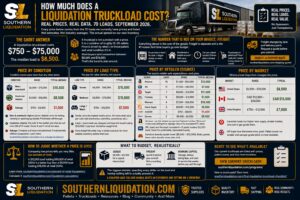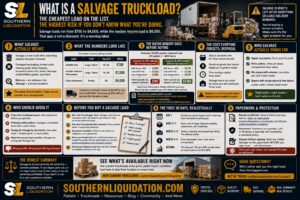
Salvage is the cheapest thing on any liquidation seller’s list, usually by an enormous margin. Across our current inventory, salvage loads run from $750 to $4,000 while the median truckload of customer returns is $8,500.
That gap is not a discount. It is a warning label, and reading it correctly is the difference between the best-value load you will ever buy and an expensive pile of rubbish in your unit.
If you want the broader definitions — overstock, shelf pulls, customer returns and salvage as grades — we covered those in our guide to pallet grading. This article is about salvage specifically, at truckload scale, where the economics behave differently.
What salvage actually means
Salvage is what is left after everything sellable has been removed.
A customer returns load contains goods a customer sent back — many of which work perfectly, some of which are damaged. A salvage load contains goods that have already been through that sorting process and failed it. Damaged packaging, broken units, missing parts, items pulled from a store closure or an insurance write-off, goods that got wet, goods nobody could identify.
The critical distinction: with returns you are buying an unknown mix. With salvage you are buying a known problem. The seller is not hiding anything. The price says exactly what it is.
What the numbers look like
Our three current salvage loads give a fair picture of the range:
| Load | Type | Pallets | Price |
|---|---|---|---|
| AOSOM (UK) | Large / Mech | 15–23 | £750 |
| Auction cleanout (Tennessee) | Large / Mech | 15–24 | $1,500 |
| Chips (Arkansas) | Smalls | 24 | $4,000 |
Compare that to the same trailer filled with customer returns at $8,500, or new stock at $10,500, and you can see why salvage attracts attention. You are paying somewhere between 10% and 45% of what a conventional load costs for the same physical volume.
The maths nobody does before buying
Here is the calculation that decides whether salvage works.
On a returns load, you might expect to sell 70% of units at a reasonable price. On salvage, assume something closer to 20% to 40% — and be honest that you cannot know the figure in advance, because salvage is rarely manifested.
Take the $1,500 auction cleanout load. Say it holds 20 pallets and roughly 800 items. If 30% are sellable at an average of $12 each:
- 240 sellable items × $12 = $2,880 revenue
- Less the load at $1,500 and freight at, say, $1,200 = $180 profit
That is before your time, before fees, and before you deal with the 560 items you could not sell. On those numbers the load loses money the moment anything goes slightly wrong.
Now run it at 40% sellable and $18 average:
- 320 items × $18 = $5,760 revenue
- Less $1,500 and $1,200 freight = $3,060 profit
Same load, same price, wildly different outcome — driven entirely by two numbers you cannot verify before it arrives. That is the honest description of salvage: a bet on your own processing ability, not a purchase of known goods.
Run your own version before you buy with our load profitability calculator, and read how percent of retail works so you are not comparing salvage to returns as though they were the same product.
The cost everyone forgets: disposal
On a returns load, unsold stock is a nuisance. On a salvage load, a large share of what arrives is waste — and waste has a cost.
- Skip or dumpster hire for what cannot be sold
- Electrical goods that cannot legally go in general waste
- Your time sorting rubbish from stock, which is the same time you are not spending listing
- Storage space occupied by items you will eventually throw away
Budget for it explicitly. A load that pencils out at a small profit before disposal costs usually does not after.
Who salvage actually works for
Salvage is a genuine opportunity for a specific kind of operator:
- Repair specialists. If you can fix what others discard, salvage is where your skill turns into margin. Broken is only broken if you cannot mend it.
- Parts sellers. A dead appliance is worthless as a unit and valuable as components. This is a real business, and salvage is its natural supply.
- Bin stores with volume. Low price per unit is exactly what a $7-Monday model needs. Sellable-but-scruffy goods are a problem online and perfectly fine in a bin.
- Buyers with cheap space and free labour. If storage costs you nothing and you are doing the work yourself, the maths tolerates a much lower sell-through rate.
Who should avoid it
Equally plainly:
- First-time truckload buyers. Learn what a normal load looks like before you take on an abnormal one. You cannot judge whether a salvage load was bad if you have no baseline.
- Anyone selling primarily online. Individual listings with photos, condition notes and returns handling do not suit goods that are scratched, incomplete or unbranded.
- Anyone paying for storage by the month. Slow-moving low-value stock and rented space are a bad combination.
- Anyone who needs the money back quickly. Salvage is a long-tail sell. If the cash needs to return within weeks, this is the wrong load.
Before you buy a salvage load
- Ask why it is salvage. Water damage, a store closure, an insurance write-off and picked-over returns all produce very different loads at the same grade.
- Ask what has already been removed. Salvage that has been cherry-picked twice is not the same as an untouched cleanout.
- Assume no manifest. If there is one, treat it as indicative rather than a contract.
- Price your freight first. On a £750 load, freight can easily exceed the goods. Get the quote before you commit — the landed cost is the only number that matters.
- Decide your disposal route now. Not after 8 pallets of unsellable stock are in the way.
The honest summary
Salvage is the only category where we routinely tell people not to buy. Not because the loads are bad — they are priced correctly for what they are — but because the buyer profile is narrow and the failure mode is expensive.
If you repair, part out, or run high-volume low-ticket sales, salvage may be the best value on our list. If you are buying your first truckload, start with customer returns and come back to salvage once you know what you are looking at. Our pre-purchase checklist is the place to start.