The most common question we get is also the one almost nobody in this industry answers publicly: what does a liquidation truckload actually cost?
Search it and you will mostly find category pages inviting you to enquire. That is not an accident. Pricing is the thing liquidation sellers are least willing to put in writing, because it invites comparison.
So here are ours. Every figure below comes from the 70 loads we currently have priced and listed. Not estimates, not industry averages — the actual spread on our own inventory as of September 2026.
The short answer
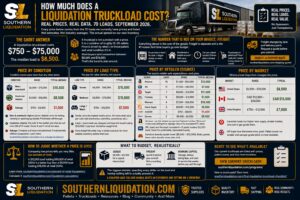
A liquidation truckload costs between $750 and $75,000. The median load is $8,500.
That range is enormous, and the width of it is the real answer to the question. A truckload is not a product with a price. It is a container of between roughly 15 and 26 pallets, and what determines the price is what is on those pallets and what condition it is in.
Most buyers land somewhere between $6,000 and $16,000. If you are budgeting for a first load, that is the band to plan around.
Price by condition
Condition moves price more than any other single factor.
| Condition | Range | Typical (median) |
|---|---|---|
| New / overstock | $6,000 – $75,000 | $10,500 |
| Customer returns | $4,500 – $55,000 | $8,500 |
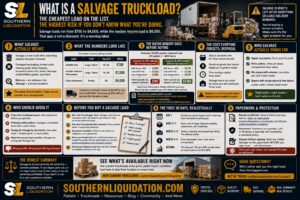
| Salvage | $750 – $4,000 | $1,500 |
New and overstock loads carry the highest prices because the goods are sellable as-is. Nothing needs testing, cleaning or repackaging, and your sell-through rate is predictable.
Customer returns sit in the middle. This is the bulk of the market and the bulk of what we sell — 50 of our 70 priced loads. The price reflects the fact that some percentage of every load will not be sellable at full value.
Salvage is the cheapest and the most misunderstood. A $750 salvage load is not a bargain version of an $8,000 returns load. It is a fundamentally different proposition, and we have written separately about what salvage actually means and who should buy it.
Price by load type
This is where new buyers get surprised. The intuitive assumption is that bigger items cost more. The opposite is true.
| Load type | Range | Typical (median) |
|---|---|---|
| Smalls | $4,000 – $55,000 | $15,500 |
| Mediums | $4,500 – $75,000 | $10,000 |
| Large / Mech | $750 – $10,000 | $7,500 |
Smalls carry the highest median price of any load type. A pallet of small items — electronics, cosmetics, accessories, phone gear — holds far more retail value per cubic foot than a pallet of patio furniture. You are paying for value density, not volume.
Large and mechanical loads are the cheapest per truckload and have the lowest ceiling in our inventory at $10,000. They fill a trailer quickly. You hit the cube limit long before you hit the weight limit, which means fewer units and less total retail value in the same 53 feet.
This matters for a practical reason: if you are paying the same freight bill either way, a smalls load puts far more sellable inventory behind that cost.
Price by retailer
The source retailer sets expectations about what is inside, and the market prices accordingly.
| Source | Loads | Range | Typical |
|---|---|---|---|
| Amazon | 16 | $1,500 – $50,000 | $15,000 |
| 3PL | 11 | $7,500 – $10,000 | $7,500 |
| Target | 7 | $6,500 – $15,500 | $11,500 |
| Costway | 6 | $6,000 – $12,000 | $7,500 |
| Walmart | 4 | $7,500 – $16,500 | $10,500 |
| Home Depot | 3 | $6,500 – $16,500 | $9,500 |
| AOSOM | 3 | $750 – $8,000 | $5,000 |
| Garvee | 2 | $8,000 – $8,500 | $8,500 |
Amazon has both the widest spread and the highest median. That is because “Amazon” covers everything from a salvage load of unprocessed returns to a $50,000 truckload of new, processed fulfilment-centre stock. The name tells you the source, not the value.
3PL loads are the most consistently priced on our list — eleven loads inside a $2,500 band. Third-party logistics returns tend to be mixed general merchandise with a predictable profile, which is why they suit buyers who want to repeat the same purchase month after month.
The furniture brands — Costway, AOSOM, Yitahome — cluster lower, between $5,000 and $12,000. Bulky goods, lower value density, and the same cube limit described above.
Price by market
Where a load ships from changes the price, sometimes substantially.
| Market | Range | Typical |
|---|---|---|
| United States | $1,500 – $75,000 | $8,500 |
| Canada | CAD $12,000 – $29,000 | CAD $15,000 |
| United Kingdom | £750 – £12,000 | £7,000 |
Canadian loads run noticeably higher than US equivalents. Less supply, a smaller domestic liquidation market, and the cost of getting goods there in the first place all feed into it. If you are buying in Canada, budget above what a US comparison would suggest.
UK loads have the lowest entry point of any market we operate in, largely because pallet counts run smaller and salvage-grade stock is available at prices that do not exist in the US market.
The number that is not on your invoice
Everything above is the cost of the goods. It is not what the load costs you.
Freight is a separate bill, and it is the single most common reason a first-time truckload purchase goes over budget. What you pay depends on the distance, the lane, and — critically — what happens at your end:
- Do you have a dock? If not, the truck needs a liftgate, and that is an added charge on every delivery.
- Is the address residential or limited-access? Both carry surcharges, and a business operating from a home address usually counts as residential.
- Can you unload quickly? Drivers allow a limited window. Beyond it, detention charges start.
- Is the load floorloaded or palletised? A floorloaded trailer is cheaper to buy and considerably slower to unload.
The honest answer on freight is that we cannot publish a table for it the way we can for goods, because it changes per lane and per delivery point. What we can do is quote it before you commit — request a shipping quote and you will have the landed number before you buy, not after.
How to judge whether a price is good
Comparing two truckload prices against each other tells you very little. A $6,000 load and a $12,000 load are not competitors; they are different products.
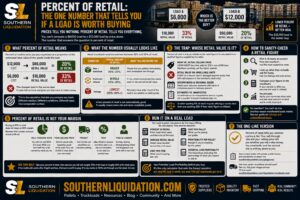
The number that actually lets you compare is percent of retail — what you are paying as a proportion of the estimated retail value of the goods inside. A $12,000 load holding $60,000 of retail is a better buy than a $6,000 load holding $18,000, despite costing twice as much.
That calculation, and the traps in it, deserve their own explanation. We have written it up here: Percent of Retail: the one number that tells you if a load is worth buying. You can also run the numbers directly with our load and pallet calculators.
What to budget, realistically
If you are buying your first truckload and want a planning figure rather than a range:
- Goods: $8,000 – $12,000 for a typical returns load
- Freight: quote it before you commit; it is not a rounding error
- Working capital beyond the load: storage, labour, listing fees and the cash to survive the weeks before you have sold through
The mistake we see most often is a buyer spending every available dollar on the load itself and having nothing left to actually process it. A cheaper load you can handle beats an expensive one sitting on a driveway.
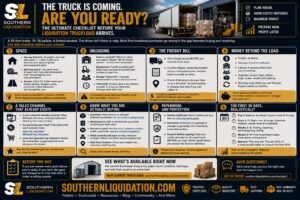
If you want to see what is actually available at each price point right now, our current truckloads are listed here with prices, pallet counts and ship-from locations on every one. And if you are working through a first purchase, our pre-purchase checklist covers what to have in place before the truck arrives.