This article is general information, not tax advice. We sell truckloads; we are not accountants. VAT rules change and the details of your situation matter enormously. Use this to know what questions to ask, then ask them of a qualified accountant and check the current rules at gov.uk/vat-margin-schemes.
Buying liquidation stock at truckload scale will push most UK resellers past the VAT registration threshold sooner than they expect. When it happens, a second question arrives immediately: do you charge VAT on the full selling price of every item, or only on your margin?
For a lot of liquidation resellers the answer is the margin — and the difference to your bottom line is substantial.
What the margin scheme actually does
Under normal VAT accounting, you charge VAT on the full sale price and reclaim VAT on what you paid.
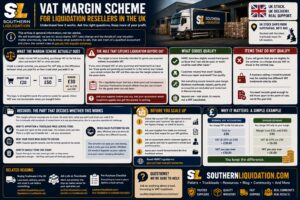
Under a margin scheme, you account for VAT only on the difference between what you paid for an item and what you sold it for. If you bought something for £20 and sold it for £50, VAT is calculated on the £30 margin, not on the £50.
The logic is straightforward: the scheme exists for goods where VAT was not recoverable when you bought them. Without it, the same goods would effectively be taxed twice.
The rule that catches liquidation buyers out
This is the part worth understanding before you buy, not after.
The margin scheme is broadly intended for goods you acquired without recoverable VAT. If you were charged VAT on your purchase and reclaimed it as input tax, those goods are generally accounted for in the normal way instead — you cannot reclaim the VAT and then also use the margin scheme on the same items.
For a liquidation buyer that has a direct practical consequence: how your truckload is invoiced affects how you can account for the goods when you sell them. A load invoiced with VAT and a load acquired without recoverable VAT put you in different positions.
Ask the question before you buy. Ask your accountant which treatment applies to the specific way your supplier invoices, and get the answer in writing. This is not something to work out after the stock has arrived and been sold.
What goods qualify
HMRC’s guidance describes eligible second-hand goods as those that “can still be used, or which could be used after repair.”
That phrasing matters for this trade. A customer return that works is second-hand goods. A damaged item you intend to repair and sell can be too. Something genuinely beyond use is not stock at all — it is waste, and it belongs in the disposal budget rather than the VAT calculation.
Note also that certain things cannot go into a margin calculation even when they relate to goods you are selling under the scheme. HMRC specifically excludes business overheads, repairs, parts and accessories — those are reclaimed on your VAT return in the normal way rather than added to the purchase price to reduce your margin.
So if you buy a £20 item, spend £15 on a replacement part, and sell it for £60, you cannot simply treat your margin as £25. The part is handled separately. Get this confirmed for your circumstances — it is exactly the sort of detail that gets missed.
Items that do not qualify
If you sell goods that are not eligible for the scheme, you charge and pay VAT on those in the normal way. Practically, that means a business selling a mixed truckload may be running two different VAT treatments side by side — margin scheme on qualifying second-hand goods, standard accounting on everything else.
That is manageable, but only with records good enough to tell them apart at the point of sale rather than at the year end.
Records: the part that decides whether this works
The margin scheme is not a calculation you can reconstruct later from a bank statement. It requires you to know, for each item, what you paid and what you sold it for.
For a reseller buying single pallets, that is tedious. For a reseller buying a 23-pallet truckload with hundreds of mixed items and no per-item purchase price, it is a genuine operational problem — and it is the reason some liquidation resellers who could benefit from the scheme do not use it.
Practical points to raise with your accountant:
- How to apportion a truckload price across items. You paid one figure for the whole load. The scheme works per item. There is a right way to handle this and you should be told what it is before you start.
- What your stock book needs to contain. HMRC requires specific records; get the format agreed at the outset rather than retrofitting it.
- How to handle items you scrap. Goods that go in the skip never get sold, so they never generate a margin — but they were part of what you paid for.
- Whether your sales platform gives you what you need. eBay, Whatnot and a bin store till produce very different records.
The honest summary: the scheme can save you real money, and it costs you real admin. Whether it is worth it depends on your volume and your record-keeping discipline, and that is a conversation with an accountant rather than a decision to make from an article.
Before you scale up
If you are moving from pallets to truckloads, sort this out at the same time. The moment you increase purchase volume you change your VAT position, and the treatment of your stock is easier to set up correctly than to unpick.
- Check the current VAT registration threshold and where your turnover sits against it — the figures change, so check them at source.
- Ask your supplier how loads are invoiced, and what that means for your VAT position.
- Ask an accountant which treatment applies to your goods and how to apportion a whole-load purchase price.
- Agree your record format before the first truckload arrives.
Read HMRC’s own guidance at gov.uk/vat-margin-schemes — it is the authoritative source and it is clearer than most summaries of it.
Related reading
If you are weighing up the move to buying at scale, our guide to buying liquidation truckloads in the UK covers load sizes, delivery and access, and job lots vs truckloads works through whether the step up makes sense for your operation yet.
Our current UK stock ships from Gateshead, and if you need to know how a specific load would be invoiced before you commit, just ask us.
Related truckloads
Looking for inventory? Browse our Amazon processed FC truckloads (UK), Costway truckloads (UK) and Greenworks truckloads (UK), or see all available truckloads and pallets.