Most UK resellers buy job lots. A pallet here, a mixed lot there, an auction win when something good comes up. It works, it is low risk, and it is how nearly everyone starts.
The question that eventually arrives is whether to buy a whole truckload instead. Usually it gets answered on ambition — bigger feels like progress. That is the wrong basis, and it is why some resellers who step up too early end up with 23 pallets they cannot process and a cash flow problem.
Here is the actual comparison.
The terms, since they get used loosely
- Job lot. A quantity of mixed stock sold as one batch. Could be two boxes, could be several pallets. The defining feature is that it is a bundle, not a standard unit.
- Pallet. One pallet of goods, typically shrink-wrapped, roughly 1.2m x 1m and stacked to somewhere between 1.5m and 2m.
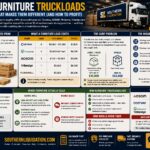
- Truckload. A full vehicle. In the UK that is usually 15 to 24 pallets — smaller than the 24–26 you will read about on American sites.
“Job lot” is the native British term and covers everything from a car boot’s worth to several pallets. That flexibility is useful when buying and unhelpful when comparing, because two job lots can differ by a factor of fifty.
Cost per unit is the whole argument
The case for a truckload is simple: you pay less per item. The case against is everything that has to be true for that saving to be real.
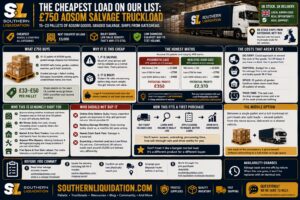
Take our Costway UK load — 23 pallets of customer returns at £7,000. That is roughly £304 per pallet. Buying comparable single pallets on the open UK market generally costs several times that. The saving is genuine and it is substantial.
But it only exists if you can:
- Take delivery of 23 pallets at once
- Store them while you work through them
- Process them before the cash runs out
- Sell them without flooding your own channel
Fail any of those and the per-unit saving evaporates, because the real cost of a truckload is not the invoice. It is the working capital tied up in stock you have not yet sold.
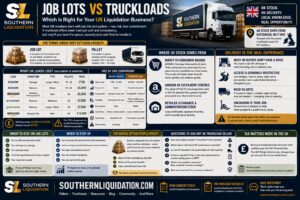
Side by side
| Job lot / pallets | Truckload | |
|---|---|---|
| Typical outlay | £100 – £1,500 | £5,000 – £12,000 |
| Cost per unit | Higher | Considerably lower |
| Storage needed | A garage or spare room | Roughly 800–1,200 sq ft |
| Unloading | Two people and a van | Tail lift, pallet truck, a team, a booked slot |
| Time to process | Days | Weeks |
| Cash tied up | Small, recycles quickly | Large, recycles slowly |
| Consistency | Varies lot to lot | One source, one profile |
| Risk of a bad buy | Annoying | Serious |
The consistency point nobody mentions
There is an advantage to truckloads that has nothing to do with price, and for established resellers it often matters more.
Buying job lots means every purchase is a different mix from a different source. Your listings are permanently varied, your knowledge never compounds, and you cannot predict next month’s stock.
A truckload from a single source is one profile at volume. Twenty-three pallets of Costway returns are twenty-three pallets of broadly similar goods. You learn what sells, what does not, what the common faults are and what your realistic sell-through rate is — and then you can buy the same thing again and know what you are getting.
For anyone running a bin store, a regular live show or a market pitch, that predictability is worth as much as the discount.
When to stay on job lots
Stay where you are if any of these are true:
- You are still learning what sells. Buy variety while you work that out. A truckload is a commitment to one answer.
- Your storage is a garage. Twenty-three pallets will not fit, and stock stored badly gets damaged.
- You sell part-time. Processing a truckload around a full-time job takes months, and the cash is dead the whole time.
- You would be spending most of your capital. Never put your working capital into a single load. You need money left to actually run the business.
- Your channel is small. Selling 23 pallets through an eBay account doing ten sales a week is a two-year project.
When to step up
The signals that you are genuinely ready:
- You are buying the same kind of stock repeatedly. You already know what you want, so you may as well buy it wholesale.
- You are running out of stock before you run out of demand. The clearest signal there is.
- You have somewhere to put it. A unit, a barn, a yard with a container — anywhere you can take a pallet delivery and work.
- You can unload it. Access for the vehicle, a pallet truck, and people available on the day.
- You can survive the gap. Money spent on the load will not come back for weeks. If that is uncomfortable, wait.
The middle option people forget
It is not a binary. Between a single pallet and a full truckload sit part-loads and split loads — several pallets from the same source, delivered on a shared vehicle.
You get most of the consistency benefit and much of the price benefit without committing to a full trailer or needing space for one. If you are on the edge of the decision, ask about a part-load first. It is a far cheaper way to find out whether a source suits you than buying 23 pallets of it.
Work out your own number
Rather than deciding on instinct, put the figures in. Our load and pallet calculators will give you cost per pallet, cost per item and projected load profitability, so you can compare a truckload against what you currently pay per pallet on a like-for-like basis.
Then read how percent of retail works, because that is the number that tells you whether the truckload is genuinely cheaper or merely bigger.
If you decide to move up
Our current UK stock shows pallet counts, conditions and prices on every load, and our guide to buying truckloads in the UK covers delivery, access and what to ask before committing. Work through the pre-purchase checklist before you buy anything.
And if you are not sure whether you are ready, ask us. We would rather sell you a part-load you can handle than a truckload you cannot.
Related truckloads
Looking for inventory? Browse our Amazon processed FC truckloads (UK), Costway truckloads (UK) and Greenworks truckloads (UK), or see all available truckloads and pallets.