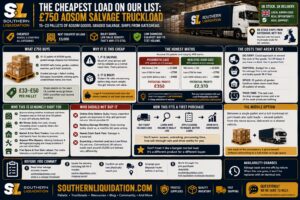
The cheapest load on our entire list — across three countries and every category we sell — is an AOSOM salvage truckload sitting in our Gateshead warehouse at £750.
The next cheapest UK load is £5,000. The one after that is £6,000.
That gap is not a typo or a promotion. It exists because a salvage load is a fundamentally different product from everything else on the list, and understanding why is the difference between the cheapest way into this business and the most expensive mistake in it.
What £750 buys
Between 15 and 23 pallets of AOSOM goods, graded salvage, shipping from Gateshead.
AOSOM sells home, garden and outdoor products direct to consumers — garden furniture, pet equipment, exercise gear, storage, kids’ outdoor toys. Bulky items, mostly flat-packed, mostly delivered by courier.
Graded salvage, that means goods that have already failed a sorting process. Damaged packaging, missing hardware, courier-damaged units, returns that came back incomplete, items nobody could identify well enough to resell conventionally.
At £750 for up to 23 pallets you are paying roughly £33 to £50 per pallet. Single pallets on the open UK market rarely go below £150 and often cost several hundred.
Why it is this cheap
Two reasons, and both matter.
First, it is salvage. Much of what arrives will not be sellable as a normal retail item. That is priced in, openly.
Second, and less obvious: it is bulky. AOSOM goods are large and light. A trailer fills with volume long before it reaches weight, so you get a lot of physical stuff and relatively little retail value per cubic metre. Large and mechanical loads have the lowest ceiling of any load type we sell.
You are buying volume, not value. Whether that is good depends entirely on what you do with volume.
The honest maths
Assume 20 pallets and roughly 400 items — bulky goods mean fewer units per pallet than a smalls load.
The pessimistic case. 25% sellable at £15 average:
- 100 items × £15 = £1,500
- Less £750 for the load and, say, £400 delivery = £350
The realistic-good case. 40% sellable at £22 average:
- 160 items × £22 = £3,520
- Less £750 and £400 = £2,370
Both outcomes are plausible. The difference is your ability to fix, clean, complete and photograph goods that arrived in poor condition — plus a genuine tolerance for throwing things away.
Note that even the pessimistic case does not lose money. That is the actual argument for this load: the downside is small. Losing £350 of upside on a £750 load is a survivable education. Making the same misjudgement on a £12,000 load is not.
Run your own numbers with our load profitability calculator before committing.
The costs that are not the £750
On a load this cheap, everything else looms much larger in proportion.
- Delivery. Could approach or exceed the cost of the goods. A tail lift is likely if you have no dock. Get it quoted first — the landed cost is the only figure that means anything here.
- Disposal. Budget for a skip. On salvage this is not optional, and bulky goods fill a skip fast.
- Space. Twenty pallets of garden furniture takes more room than twenty pallets of smalls. Bulky is bulky whether it sells or not.
- Your time. The real cost. Sorting salvage is slow, and a lot of the work produces nothing.
Who this is genuinely right for
- Anyone testing whether truckloads suit them. This is the cheapest realistic way to find out what 20 pallets in your unit actually feels like.
- Bin stores. Bulky, low-cost, visually interesting stock is exactly what a bin store model wants. Scruffy packaging matters far less in a bin than in a listing.
- Market and car boot traders. Low unit cost, sold face to face, no returns process, no shipping on bulky items.
- Anyone who repairs. Missing hardware and damaged packaging are cheap problems if you can solve them.
- Anyone with free space and their own labour. The maths tolerates a much lower sell-through when storage and hours cost you nothing.
Who should not buy it
- Online-only sellers shipping individually. Bulky, heavy, imperfect goods are expensive to ship and generate returns. This is the worst possible fit.
- Anyone renting storage monthly. Slow-moving bulky stock against a monthly bill goes wrong quietly.
- Anyone who needs cash back fast. Salvage is a long tail.
- Anyone expecting a normal load at a low price. It is not one. If that is what you want, our conventional UK returns loads start around £5,000 and behave completely differently.
How this fits a first purchase
The standard route into truckloads is to save up, buy one conventional load, and hope. A £750 salvage load offers a different path: find out cheaply whether you can handle volume at all.
You learn whether your access works for an artic, whether your unloading plan survives contact with reality, how long processing actually takes, and what your genuine sell-through rate is. Those lessons are considerably cheaper here than on a £7,000 load.
What you should not do is treat it as a bargain version of a normal load. It is a different product with a different buyer.
Before you commit
- Read what salvage actually means so you know what is arriving.
- Quote the delivery, including a tail lift if you have no dock.
- Confirm an artic can physically reach you.
- Arrange your disposal route before the load arrives.
- Work through the pre-purchase checklist.
Availability changes — salvage loads are one-offs by nature, and when this one goes it will not be replaced with an identical one. Current UK stock is listed here, and if you want to know whether this specific load suits what you do, just ask. We will tell you if it does not.