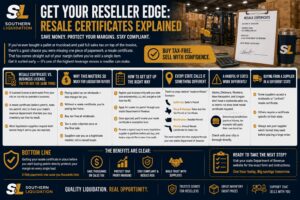
If you’ve ever bought a pallet or truckload and paid full sales tax on top of the invoice, there’s a good chance you were missing one piece of paperwork: a resale certificate. Without one, every supplier is required to charge you sales tax on the full purchase price of every load you buy, whether it’s a $500 mixed pallet or a $15,000 truckload. That tax comes straight out of your margin before you’ve sold a single item, so getting this sorted out early is one of the highest-leverage things a new reseller can do.
Resale Certificate vs. Business License: They’re Not the Same Thing
A business license is permission from your city or county to operate a business at all. A resale certificate (sometimes called a seller’s permit, sales tax permit, or reseller’s permit depending on the state) is a separate document from your state’s revenue department that lets you buy inventory tax-free because you’re planning to resell it, not use it yourself. Liquidation suppliers and marketplaces require a copy of this certificate on file before they’ll sell to you tax-exempt, so most resellers actually need both documents before they place their first order.
Why This Matters So Much for Liquidation Buyers
Retail arbitrage and liquidation resale run on thin margins to begin with. If you’re paying sales tax on the wholesale purchase price of every pallet and then collecting sales tax again when you resell each item individually, you’re effectively paying tax twice on the same merchandise. A resale certificate breaks that cycle: you buy tax-free at the wholesale level, and tax is only collected once, at the final sale to your customer. Skipping this step doesn’t just cost you money on paper, it can also flag your account with some suppliers as a casual buyer rather than a legitimate reseller.
How to Get Set Up the Right Way
- Register your business entity with your state (sole proprietorship, LLC, etc.) and get an EIN from the IRS.
- Apply for a sales tax permit through your state’s Department of Revenue. This is usually the first document you need before you can request a resale exemption.
- Once approved, you’ll receive your resale certificate or exemption form. Some states combine this into one document, others issue them separately.
- Provide a signed copy to every liquidation supplier or platform before you buy, and keep a copy on file yourself in case of an audit.
Every State Calls It Something Different
This is where a lot of new resellers get tripped up. There’s no single national “resale certificate,” and the paperwork looks different depending on where you’re registered. A few examples: California calls it a Seller’s Permit, Texas and Georgia issue a Sales and Use Tax Permit or Certificate, Washington uses a Reseller Permit, and Florida issues an Annual Resale Certificate for Sales Tax. The document name matters less than making sure you’re applying through your own state’s Department of Revenue rather than a generic third-party site.
A Handful of States Work Differently
Alaska, Delaware, Montana, New Hampshire, and Oregon don’t have a statewide sales tax, so there’s no state-level resale certificate required to buy tax-free in those states. That said, some local jurisdictions (parts of Alaska, for example) still apply their own local tax, so it’s worth checking with your city or borough directly rather than assuming you’re fully exempt.
Buying From a Supplier in a Different State
If you’re buying from a liquidator based in another state, some will accept a multistate or “uniform” resale certificate, while others require a certificate specific to their state. It’s always worth asking your supplier directly which format they need before you place a large order, so you’re not caught paying tax you didn’t need to.
Bottom Line
Getting your resale certificate in place before you start buying pallets isn’t just a formality, it directly protects your margin on every single load. It’s a one-time setup that takes a bit of paperwork up front but pays for itself the very first time you avoid sales tax on a truckload purchase. If you’re not sure where to start, your state Department of Revenue’s website will have the exact form and instructions for your situation, and it’s worth the hour it takes to get it done before your next order.