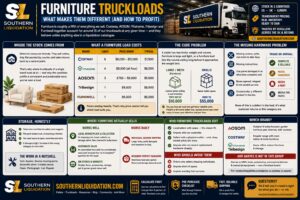
Furniture is roughly a fifth of everything we sell. Costway, AOSOM, Yitahome, Tribesign and Furniwell together account for around 15 of our truckloads at any given time — and they behave unlike anything else in a liquidation catalogue.
If you have bought general merchandise returns before, most of what you know transfers badly. Here is what is actually different.
Where the stock comes from
These are direct-to-consumer brands. They sell online, ship flat-packed by courier, and take returns back to a central point. That is why whole truckloads of a single brand exist at all — the returns are already consolidated before anyone liquidates them.
It also explains the condition profile. These goods have been through a courier network twice, in a box, assembled by a customer or not, and sent back. The damage patterns are consistent and predictable once you have seen a load.
What a furniture load costs
| Brand | Loads | Price range | Typical |
|---|---|---|---|
| Costway | 6 | $6,000 – $12,000 | $7,500 |
| Yitahome | 4 | $8,500 (all four) | $8,500 |
| AOSOM | 3 | £750 – $8,000 | $5,000 |
| Tribesign | 1 | $8,500 | $8,500 |
| Furniwell | 1 | $6,500 | $6,500 |
Furniture loads cluster between $5,000 and $12,000 — below the median for our inventory overall. That looks like value until you understand why.
The cube problem
This is the single most important thing to understand about furniture truckloads.
A trailer has two limits: weight and volume. Furniture is large and light, so a furniture load hits the volume ceiling long before it approaches the weight limit. The trailer is full, but it contains far fewer units and far less total retail value than the same trailer filled with smalls.
You can see it in our own numbers. Large / Mech loads — which is where most furniture sits — have the lowest price ceiling of any load type we sell, topping out at $10,000. Smalls loads, in the same physical space, run to $55,000.
Two practical consequences:
- You pay less per load and get fewer sellable units. The cheap price is not a discount, it is a smaller quantity of value.
- Freight is the same either way. You pay to move a full trailer regardless of what is in it. On a furniture load that freight cost is spread across less retail value, which raises your effective cost per item considerably.
Always calculate landed cost per unit, not the load price. Our cost per item calculator will do it, and percent of retail is the number that makes loads comparable.
The missing hardware problem
Flat-pack returns arrive incomplete more often than any other category. A customer opens the box, starts assembling, gives up, and sends it back — sometimes with the fixings bag, often without.
What you will find:
- Missing screws, bolts, cam locks and allen keys
- Missing instructions, which for some products makes assembly guesswork
- One panel damaged in an otherwise complete unit
- Boxes that have been opened, retaped and are impossible to sell as new
- Occasionally, an entirely different product in the box
None of this is a defect in the load. It is what customer returns in this category are, and it is priced accordingly. Your margin comes from being better at solving it than the last person.
Sort into four piles on arrival: complete and sellable, needs hardware, needs a part, break for parts. The triage is the job.
Storage, honestly
Twenty-four pallets of furniture takes more room than twenty-four pallets of anything else, and the boxes are awkward — long, flat, heavy enough to be difficult and light enough to be flimsy.
Stacking is limited because flat-pack boxes crush. You will use more floor space than the pallet count suggests, and you need room to open and assemble as well as store.
If storage is tight, furniture is the wrong category to start with.
Where furniture actually sells
Channel choice matters more here than anywhere else, because shipping is the constraint.
Works well:
- Local marketplace and collection. No shipping cost, buyer collects, no damage claims. For bulky furniture this is usually the whole business.
- Assembled sales. An assembled item sells for considerably more than a box, and assembling it solves the “is it complete?” question for the buyer.
- Bin stores and markets, for the smaller items. Accessories, storage, small pet and garden goods move well.
Works badly:
- Individual courier shipping. Large, heavy, easily damaged, and a return costs you twice.
- Anything requiring perfect packaging. Most boxes have been opened.
Who furniture truckloads suit
- Local sellers with space. The classic fit — buy bulky, sell locally, no shipping.
- Anyone who can assemble. Turning a questionable box into a finished item is where the margin is.
- Sellers with a physical outlet. A unit, a shop, a market pitch, a bin store.
- Anyone who can source replacement hardware cheaply. Generic fixings turn incomplete stock back into sellable stock.
Who should avoid them
- Online-only sellers shipping individually. The economics do not work on bulky goods.
- Anyone short of space. This is the most space-hungry category we sell.
- Anyone wanting fast turnover. Furniture sells steadily, not quickly.
Which brand?
They are not interchangeable. AOSOM skews outdoor and bulky; Costway is broader and more indoor-weighted; Yitahome and Tribesign sit closer to home office and indoor furniture. And Garvee — which turns up on the same lists — is not a furniture brand at all.
We have set the differences out in Garvee vs Costway vs AOSOM, and covered Costway specifically in Costway liquidation explained.
Before you buy
Current furniture stock is on our furniture liquidation page and in the full truckload listings. Quote the freight first — on a low-value-density load it changes the maths more than the price does — and work through the pre-purchase checklist, paying particular attention to the space section.