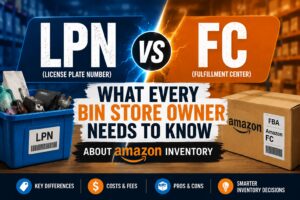
If you are running a bin store or thinking about opening one, there is one question that will define your profitability more than almost anything else — do you know what kind of inventory you are actually buying?
Specifically, do you know the difference between LPN product and FC product? Do you know how your supplier processes loads before they reach you? Do you know where to look in a pallet to make sure you are getting what you paid for?
This guide breaks down everything bin store owners need to know about Amazon inventory — from LPN vs FC to raw vs processed product, pricing strategy and how to hold your supplier accountable.
Credit to Zach at War on Retail and Built by Liquidation for the insights behind this guide.
What is LPN Product?
LPN stands for License Plate Number — Amazon’s internal tracking identifier for returned items that have been processed through their returns system.
LPN product characteristics:
- Higher average retail value per item
- Wide variety of products — no two pallets look the same
- Items are typically customer returns — may be used, opened or damaged
- Comes packaged in clear bags with a green border and an LPN barcode label
- Boxes are often more beat up from handling
- Ideal for opening day when you want to wow customers with variety and value
Think of LPN as your showstopper inventory. It is what gets customers excited, gets them talking and gets them coming back next week. Board games, outdoor gear, organizers, electronics accessories — the variety keeps people digging.
What is FC Product?
FC stands for Fulfillment Center. This is inventory that was pulled directly from Amazon’s warehouse — typically overstock, shelf pulls or items that never shipped to a customer.
FC product characteristics:
- Brand new — never been used or opened
- Lower average retail value per item
- Repeating SKUs — you may get 10 or 20 of the exact same item
- Individually bagged, new in box or new in bag
- Heavy in home goods, kitchen items, basic household products
- Lower cost per unit — typically around $1.00 to $1.15 per piece
FC is your margin builder. The cost per unit is lower which means your profit per item is higher — but the lack of variety can make it less exciting for customers on opening day.
LPN vs FC — Side by Side
| LPN | FC | |
|---|---|---|
| Condition | Returns — used or opened | Brand new |
| Retail value | Higher | Lower |
| Variety | High — wide mix | Low — repeating SKUs |
| Cost per unit | Higher | Lower (~$1.00-$1.15) |
| Best used on | Opening day ($5-6) | Later days ($1-3) |
| Packaging | Clear bag, green border, LPN label | New in box or bag |
| Customer reaction | Excitement — variety and discovery | Steady — familiar products |
How to Layer Your Bins for Maximum Profit
This is where most new bin store owners get it wrong. They fill their bins entirely with LPN on opening day to create excitement — and it works. But then they try to switch to FC the following week and customers feel ripped off. The variety is gone. The excitement disappears. Traffic drops.
The solution is to layer your bins from the start:
- Bottom of the bin — FC product. This is what will be left over on your $2 and $1 days. New items at low prices still make customers happy.
- Top of the bin — LPN product. This is what customers see first on opening day. The variety and higher value items create the excitement that drives word of mouth.
By layering from day one you train your customers to expect variety without being dependent on it. Your margins stay healthy because your overall cost per unit blends down thanks to the cheaper FC underneath.
The 3-Day Event Store Model
One of the most effective bin store formats is the 3-day event model — running your store Thursday through Saturday rather than seven days a week. Here is why it works:
- Creates FOMO — fear of missing out. Customers know they only have three days to find the good stuff
- Drives higher opening day revenue — people come in on day one because they know they cannot wait
- Prevents customers from treating your store like a traditional retail shop
- Gives you Monday through Wednesday to receive, sort and load new inventory
A common pricing model for a 3-day store is $6 / $4 / $2 — or $10 / $7 / $4 for higher value loads. The declining price creates urgency at every stage of the week.
Raw vs Processed Product — Which Should You Buy?
This is a question every bin store owner needs to answer before placing their first order.
Raw Product
Raw product means the load has not been touched since it left Amazon. The full manifest is intact. Everything is still in there — including high value items like iPads, gaming consoles and expensive electronics.
Sounds great — but for bin stores it is usually a problem. Here is why:
- You are paying a premium for high value items you cannot price correctly in a bin store environment
- If an iPad retails for $500 and you paid 8% of retail for your load — you paid $40 for that iPad. On $6 day you just lost $34
- Unless you have an eBay or Amazon FBA operation running alongside your bin store, raw product rarely makes sense
Processed Product
Processed means a supplier has gone through the raw load and removed certain categories before selling it to you — typically food, clothing and high value items over a certain price threshold (usually $90+).
Benefits of processed product for bin stores:
- Lower cost per unit — you are not paying for items you cannot monetize in a bin environment
- The sweet spot for bin stores is items retailing between $10 and $90 — processed loads are optimized for exactly this range
- More consistent piece counts per pallet
- Better margins overall
Processed does not mean you are getting inferior product. It means someone else has already pulled out the items that do not work for your business model — and charged accordingly.
Blended Pallets — What to Ask Your Supplier
Many suppliers sell blended pallets — a mix of FC and LPN product in the same pallet. This can be excellent value but you need to ask the right questions before buying:
- What percentage of the pallet is FC vs LPN? Is it 80/20? 50/50?
- Is that percentage based on volume or unit count? This is critical. A 50/50 split by volume might only be 25% LPN by unit count because FC items are smaller and pack more densely
- What is the average piece count per pallet? Know this before you buy — your entire pricing model depends on it
A good supplier will be able to answer all of these questions clearly. If they cannot — that is a red flag.
How to Check You Are Getting What You Paid For
Once your load arrives do not just trust that everything is as described. Here is what to check:
Look in the middle of the pallets
The top of a pallet is visible when it comes off the truck. The bottom gets revealed when you tip it. The middle is where shortcuts happen. Dig into the middle of a few pallets and check that the product quality matches what was described.
Count your pallets occasionally
You do not need to count every pallet every week — but count one or two per delivery. If your supplier says 350 pieces per pallet and you are consistently getting 250, that is a conversation you need to have. Your entire pricing model is built on piece count — if that number is wrong, your margins are wrong.
Know what LPN and FC look like
If you bought an LPN load and you are seeing FC labels throughout the pallets, call your supplier. A good supplier will appreciate that you know what you are looking for and will take your feedback seriously.
Know Your Numbers Before You Price
Your pricing model only works if you know your true cost per unit. If you think your cost per unit is $2 and set your opening day price at $8 — but your actual cost per unit turns out to be $4 — your margins collapse entirely.
Before every opening day run your numbers:
- Total cost of load + freight ÷ total piece count = cost per unit
- Set your opening day price at 3-5x your cost per unit minimum
- Factor in that some items will sell on $1 day — your blended average selling price matters more than your opening day price
Use our free Load & Pallet Calculator to work out your cost per unit and potential profit before you buy any load.
Source Your Bin Store Inventory from Southern Liquidation
Southern Liquidation ships Amazon smalls, general merchandise truckloads and pallet programs to bin stores across the US and UK. Our team can help you find the right load for your store size, pricing model and weekly piece count requirements.
- Browse available programs — Amazon smalls, general merchandise and more
- Get a free freight quote — know your total landed cost before you commit
- Calculate your cost per unit — free Load & Pallet Calculator
- Become a buyer — get early access to new programs
- Download our free buyer’s guide — The Complete Guide to Buying Liquidation Truckloads
Have questions about sourcing inventory for your bin store? Contact us at hello@southernliquidation.com or call +(479) 380-8606.